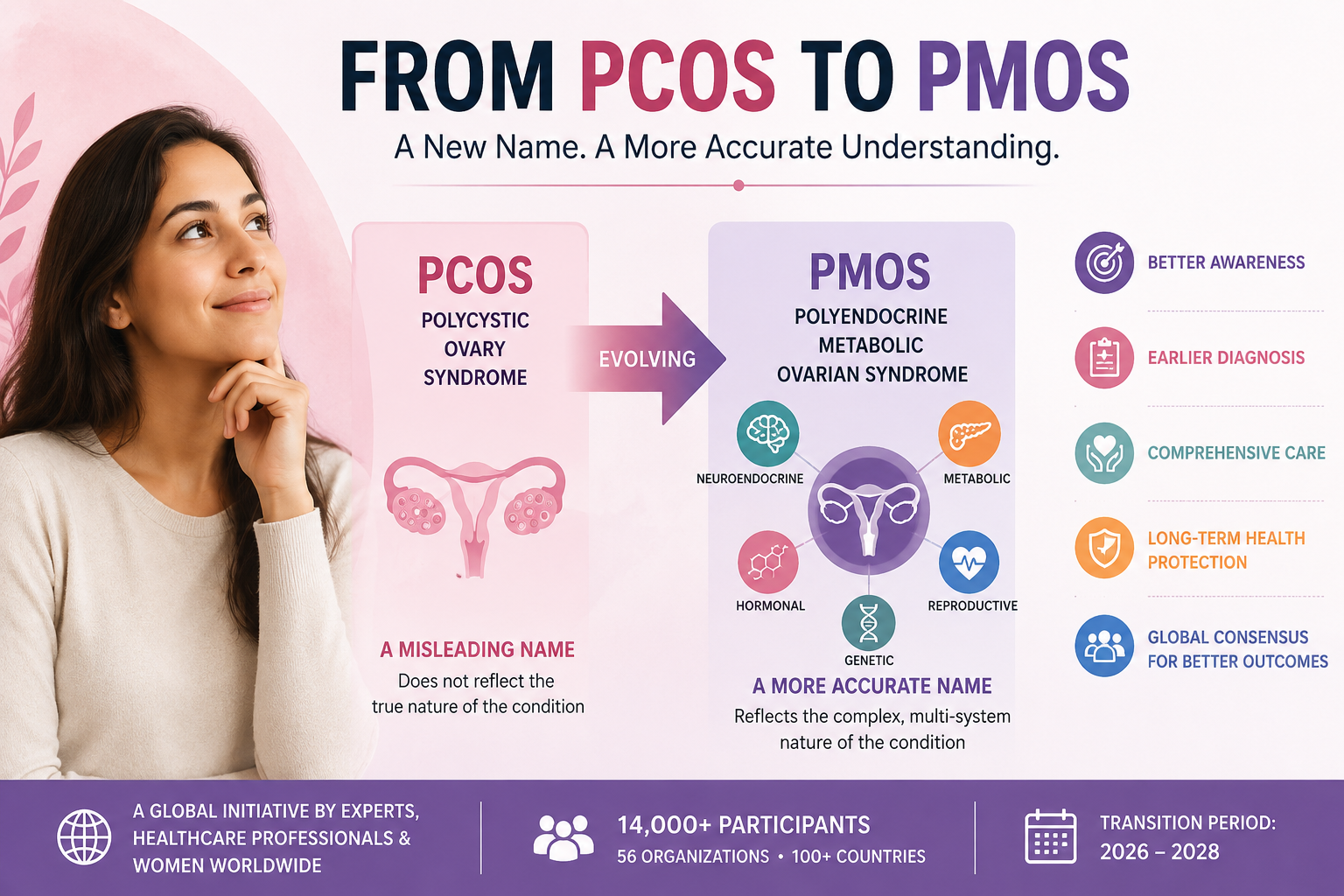








From PCOS to PMOS
For decades, millions of women across the globe have been diagnosed with Polycystic Ovary Syndrome (PCOS). However, in a historic development published in The Lancet in 2026, experts from more than 50 international organizations have agreed that the condition should now be called Polyendocrine Metabolic Ovarian Syndrome (PMOS).
This change is much more than a new name—it reflects decades of scientific progress and aims to improve awareness, diagnosis, research, and patient care.
Why Was the Name Changed?
The term Polycystic Ovary Syndrome has always been misleading.
Despite its name:
- Most women with the condition do not have ovarian cysts.
- The “cysts” seen on ultrasound are actually multiple immature follicles, not pathological cysts.
- The disease affects far more than the ovaries.
Research has shown that the condition involves complex interactions between hormones, metabolism, insulin resistance, genetics, reproductive function, and long-term cardiovascular health. The old name failed to capture these important features.
Why Is PCOS Considered a Misnomer?
The current name has several disadvantages:
- It leads many patients to believe they have ovarian cysts.
- Some clinicians focus only on menstrual irregularities or infertility.
- Important metabolic complications may be overlooked.
- Many women experience delayed diagnosis because their symptoms do not fit the common misconception of “ovarian cysts.”
- The name contributes to stigma, particularly in cultures where fertility is closely tied to social identity.
Why PMOS?
The new name better reflects the true nature of the disorder.
Polyendocrine
The condition involves multiple hormonal systems, including:
- Excess androgen production
- Insulin abnormalities
- Neuroendocrine dysfunction
- Ovarian hormone disturbances
Rather than affecting only the ovaries, several endocrine pathways contribute to the disease.
Metabolic
Insulin resistance is one of the defining features of the disorder.
Women with PMOS have an increased risk of:
- Prediabetes
- Type 2 diabetes
- Obesity
- Dyslipidemia
- Hypertension
- Fatty liver disease
- Cardiovascular disease
Recognizing the metabolic component encourages earlier screening and preventive care.
Ovarian
Although the disease affects many body systems, ovarian dysfunction remains central to diagnosis.
Women may experience:
- Irregular ovulation
- Irregular menstrual cycles
- Infertility
- Elevated Anti-Müllerian Hormone (AMH)
- Multiple small ovarian follicles
The term “ovarian” is accurate without incorrectly implying the presence of cysts.
How Was the Decision Made?
This was not a simple editorial decision.
The new terminology resulted from one of the largest international consensus exercises in women’s health.
The process included:
- More than 14,360 survey participants
- Over 10,000 women living with the condition
- Nearly 4,000 healthcare professionals
- Experts from 56 organizations
- Multiple Delphi surveys
- International workshops
- Patient advocacy groups
- Marketing and implementation experts
The consensus prioritized scientific accuracy, clarity, reduced stigma, cultural appropriateness, and practical implementation.
Will Diagnosis Change?
No.
The diagnostic criteria remain unchanged.
Adults are still diagnosed when at least two of the following are present:
- Ovulatory dysfunction
- Clinical or biochemical hyperandrogenism
- Polycystic ovarian morphology or elevated AMH (after excluding other disorders)
Only the terminology is changing—not the diagnostic standards.
What Are the Benefits of the New Name?
Experts expect several improvements:
- Better public understanding
- Earlier diagnosis
- Reduced stigma
- Greater recognition of metabolic risks
- More coordinated multidisciplinary care
- Improved research consistency
- Better health policy and disease classification
Ultimately, the goal is to improve outcomes for millions of women worldwide.
Will Everyone Start Using PMOS Immediately?
No.
The transition will occur gradually over approximately three years.
During this period:
- Medical journals will adopt the new terminology.
- Clinical guidelines will be updated.
- Electronic medical records will transition.
- Educational materials will be revised.
- International disease classification systems (including ICD) will incorporate the new name.
- The updated international guideline is expected in 2028.
What Should Patients Know?
If you have previously been diagnosed with PCOS, you do not have a different disease.
Your condition is simply being renamed to better reflect current scientific understanding.
The treatments—including lifestyle modification, weight management, ovulation induction, hormonal therapy, insulin-sensitizing medications, and long-term metabolic screening—remain the same. The new name aims to ensure that healthcare providers recognize the condition as a multisystem disorder rather than only an ovarian problem.
Final Thoughts
The transition from PCOS to PMOS represents one of the most significant updates in women’s health in recent years. By removing the misleading reference to “polycystic ovaries” and emphasizing the endocrine, metabolic, and ovarian components of the disorder, the new terminology aligns medical language with modern scientific evidence.
As clinicians, adopting this updated nomenclature can improve patient education, reduce stigma, encourage earlier diagnosis, and promote comprehensive long-term care.